On the 29th March 1849, Samuel Theophilus Tregurtha was born to James and Elizabeth (nee Tonkin); he was their 10th and last child. The family home at that time was 13 Crawford Passage, in Clerkenwell, London. It is a street that has a long and interesting heritage, which continues to have an impact today.
Crawford Passage was initially an old path that predated all other roads in the area. Unlike other parts of greater London, Clerkenwell did not develop as a result of the growing metropolis of the city, but rather as a result of the establishment of a horse market. This led to the development of taverns and places of entertainment and all of the support industries that spring up wherever there is a growing population. As the area developed, Crawford Passage grew from being a path, to a “walk”, known as Pickled Egg Walk, named after a nearby tavern of the same name. The Cock and Pickled Egg Tavern was quite a famous institution and it continued its operations right up to the time Samuel and his family were living nearby, in fact they were near neighbours of the tavern.
In addition to the tavern, among Samuel’s early neighbours, according to the 1842 Robson’s London, there was a bricklayer, a dealer in leeches, and a very large brass foundry making gas fittings and appliances. At the other end of Crawford Passage stood the back block wall of the infamous Clerkenwell Workhouse. Charles Dickens’ dire description of the workhouse, published ten years before in Oliver Twist, recounted a bleak tale. Dickens’ story took place in Clerkenwell and even in the very streets Samuel and his family walked each day. The picture of life in that part of Clerkenwell at the time of Samuel’s birth was not a rosy one, and it seems as though Samuel’s family may have been destitute and struggling.
In the 1870s and 1880s the face of Crawford Passage changed dramatically as residential dwellings were cleared to make way for warehouses, and even those were cleared in the early 1900s and following the destruction of WWII. There are few, if any, buildings in Crawford Passage that have remained the same since Samuel’s time; but the shape of the street remains unchanged. Today Crawford Passage has the distinction of being London’s narrowest street being just 5cm wide at its narrowest point.
While Samuel’s family were reasonably poor, Samuel’s childhood did not go by without the benefit of an education. Education was not a civic right in England until the 1880s, but the Victorian era saw a rise in agitation among the poor and working classes for better conditions and a rise in philanthropic advocates for better conditions. One such advocate was missionary Andrew Provan. Seeing the plight of the poor in Field Lane, Saffron Hill, immediately south of Crawford Passage, he founded the Field Lane Ragged School (later the Field Lane Ragged and Industrial School). Field Lane was the home of the poorest of the poor, as was Saffron Hill. Ragged schools were charity schools established to provide education, food and clothing to destitute children; sometimes the schools even provided a place for the child to live. Charles Dickens was saddened by the plight of the children within Clerkenwell, Saffron Hill, and Field Lane and was a great supporter and advocate of the Field Lane Ragged School. His tales A Christmas Carol and Oliver Twist were directly written in response to the lives of the children he met there.
If Samuel’s family did not have means to send Samuel to the Clerkenwell Parochial School, Samuel was likely to have been among the students of the Field Lane Ragged School. At the time Samuel was a student, the school was located on the other side of Farringdon Road in West Smithfield. There, over 340 students were daily given instruction in reading, writing, grammar, a little geography, and the girls sewing; though it wasn’t listed it can be safely assumed that a basic arithmetic were also included in the general instruction.
Samuel must have been a studious individual, because by the time he was 22, he was working as a Solicitor’s Managing Clerk and Assurance Agent for a firm in Clerkenwell.
In the Victorian era there were different classes of clerk. The highest aspiration for a clerk was to obtain a position as a stockbrokers’ clerk, the hours were good at just 7 hours work each day and not all of them chained to a desk, and the pay easily supported a comfortable middle-class lifestyle. After the stockbrokers’ clerk was the bankers’ clerk. The bankers’ clerk did not fare anywhere near as well in pay or conditions as the stockbrokers’ clerk, but he did get 2 weeks off a year. Third, was the general clerk, his day began at 8.30 in the morning and continued until 7 in the evening and often later depending on the nature of the business in which he was employed. The competition for his position was fierce which kept wages low, not only must he read and write well but the general clerk must also be able to correspond in French and/or German. Finally, the lowest class of clerk was the solicitors’ or legal clerk. Of all the clerks, the solicitors’ clerk worked the longest hours for the smallest pay and was expected to stay late without additional pay for his time.
Most clerks were only required to know shorthand and calligraphy, which ensured that there was great competition for his position which further impacted his wages. On the plus side, a junior or general solicitors’ clerk was not expected to have fine office dress or fancy hat for work. That said, not every solicitors’ firm was the same and there were some opportunities for promotion within the ranks of the solicitors’ clerk, from junior to senior clerk, and on to the penultimate, a solicitors’ managing clerk. There were clerks who enjoyed better conditions as a result of kind employers, or the natural variety a small firm might bring where only a small number of clerks were required. A clerk in a smaller firm might have the benefit of a greater variety of tasks than those employed by the larger firms who could be assigned to a specific task indefinitely. The only clerk lower than a solicitors clerk however, was the law copying clerks who were paid a paltry 1d per 72 words of copy and had no income during the court holiday season.
At the age of 30, on the 14th April 1879, Samuel married Mary Ann Maria Speer in St Peters Church, Saffron Hill (not to be confused with current St Peter’s Italian Church in Saffron Hill).

The St Peters in which Samuel and Mary married was the local parish church on Great Saffron Hill Road. It had been built in the late 1830s and so was a relatively new church compared with others in London at that time. Samuel’s address on the marriage record suggests that he was a near neighbour to the church. Unfortunately, St Peters was destroyed in 1941 during the London Blitz and subsequently demolished, nothing remains of the church, in fact so much of the local landscape has changed that we were unable to place Samuel’s residence at that time on a modern map.
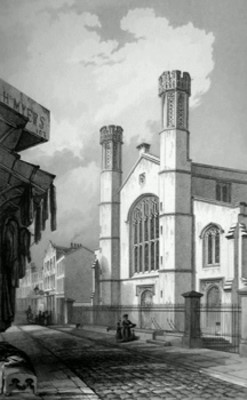
St Peter’s Church, Saffron Hill, 1839
Soon after Samuel and Mary were married they moved to Coney Hill, Gloucester, some miles away from London. We can only assume this was to advance Samuel’s career, or perhaps it was a transfer within the firm he worked for.
In 1880, while in Gloucester, Mary gave birth to their first child, a son whom they named in full Victorian flare: Cecil Theophilus Tonkin Maxwell Speer Tregurtha. In total, they would have five sons:
- 1880 – Cecil Theophilus Tonkin Maxwell Speer (died 1943)
- 1881 – Augustine St Hilary (died 1884 from measles)
- 1884 – Evelyn de St Gwinnear (died 1954)
- 1886 – Gustavius Dante (died 1889 from meningitis)
- 1888 – Archibald St John (died 1969)
It was sometime after their second son Augustine’s birth in 1881 that Samuel and his young family left Coney Hill and returned to Clerkenwell, London. There Samuel continued his career as a solicitors’ clerk.
In 1884 their 2 year old son Augustine died from a severe case of the measles, after suffering for 3 weeks with the disease.
By 1886 the family were living on Clerkenwell Close, on the eastern side of Coppice Row/Farringdon Road. Clerkenwell Close ran off Clerkenwell Green, somewhat of a misnomer as there was nothing “green” about Clerkenwell Green.
the yeaer 1889 would prove to be a most tragic year for Samuel and his young family. On the 5th March 1889, 3-year-old Gustavius Dante was suddenly struck down with meningitis and died. To lose another young son must have been a terrible blow for Samuel and Mary. However, little did the family know what would come next. It was likely that as Samuel and Mary were grieving the loss of young Gustavius, Samuel himself was becoming extremely ill. A few months after Gustavius’s death, Samuel was admitted to The Royal National Hospital for Consumption at Ventnor, on the Isle of Wight. He was suffering from extreme physical weakness and lack of energy and his body was wasting away. He was suffering from tuberculosis, specifically pulmonary tuberculosis.
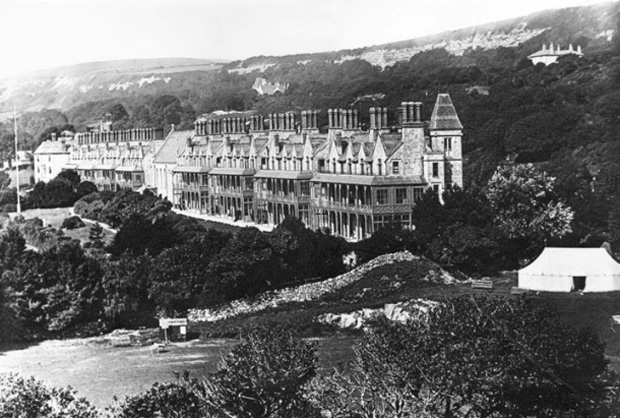
The Royal National Hospital for Consumption, Ventnor, Isle of Wight (c1900)
The tuberculosis bacteria was, and continues to be, highly infectious, and was greatly feared by all classes of men. It can remain dormant in an infected person for many long years, only developing when the immune system is compromised, either by other diseases, poor nutrition, or overwork & stress. Samuel could have picked up the bacteria in his early years on Crawford Passage or sometime later in his life, there was no way of knowing; there was also no satisfactory way of treating the disease at that time. Patients with tuberculosis were, if they could afford it, transferred to a sanitorium or tuberculosis hospital for long stays. The only treatment typically prescribed involved plenty of fresh air and sunshine, and a high calorie, nutrient dense diet. (Until the advent of penicillin and other antibiotics, there was no effective cure for tuberculosis other than assisting the body’s immune system to fight the disease itself.)
Sadly for Samuel and his family, the treatment he received did not help. On the 4th August 1889, just 5 months after the death 3-year-old Gustavius, Samuel passed away in the hospital at Ventnor. Mary instantly became a widow with 3 children under the age of 9 to care for, the youngest not yet 1 year old.
Samuel did not leave Mary destitute however. A probate record dated 1889 declared that Samuel’s last will was that Mary be the sole executor of his estate and his personal assets were valued at £148. Interestingly, there was a 2nd probate record for Samuel’s assets dated 1907 naming his eldest son, 21 year old Cecil, as the executor. The 2nd probate document was drawn up after Mary’s death and while we cannot confirm it, it seems likely that some of Samuel’s assets were still in his name, or discovered some time after his death, and Cecil had to follow due process to have these assets transferred to himself and his brothers. The 2nd probate document declares Samuel’s assets at £450, significantly more than the earlier document. Samuel had evidently invested his clerk’s income well, providing for his family not only in the present but also into the future.
Mary lived for another 11 years following Samuel’s death, then on the 23rd February 1901 she passed away from complications of paraplegia. How she came to be a paraplegic we were unable to discover. Samuel and Mary’s 3 surviving children were old enough to look after each other but the loss of both their father and mother as they entered adulthood must have taken their toll.
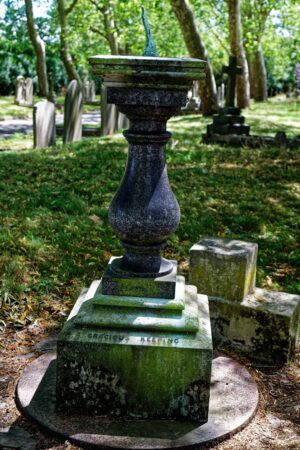
Samuel and Mary are remembered on the Tregurtha Family Memorial Sundial in the City of London Cemetery. The memorial sundial still stands today and the cemetery’s Sundial Road was named in its honour.
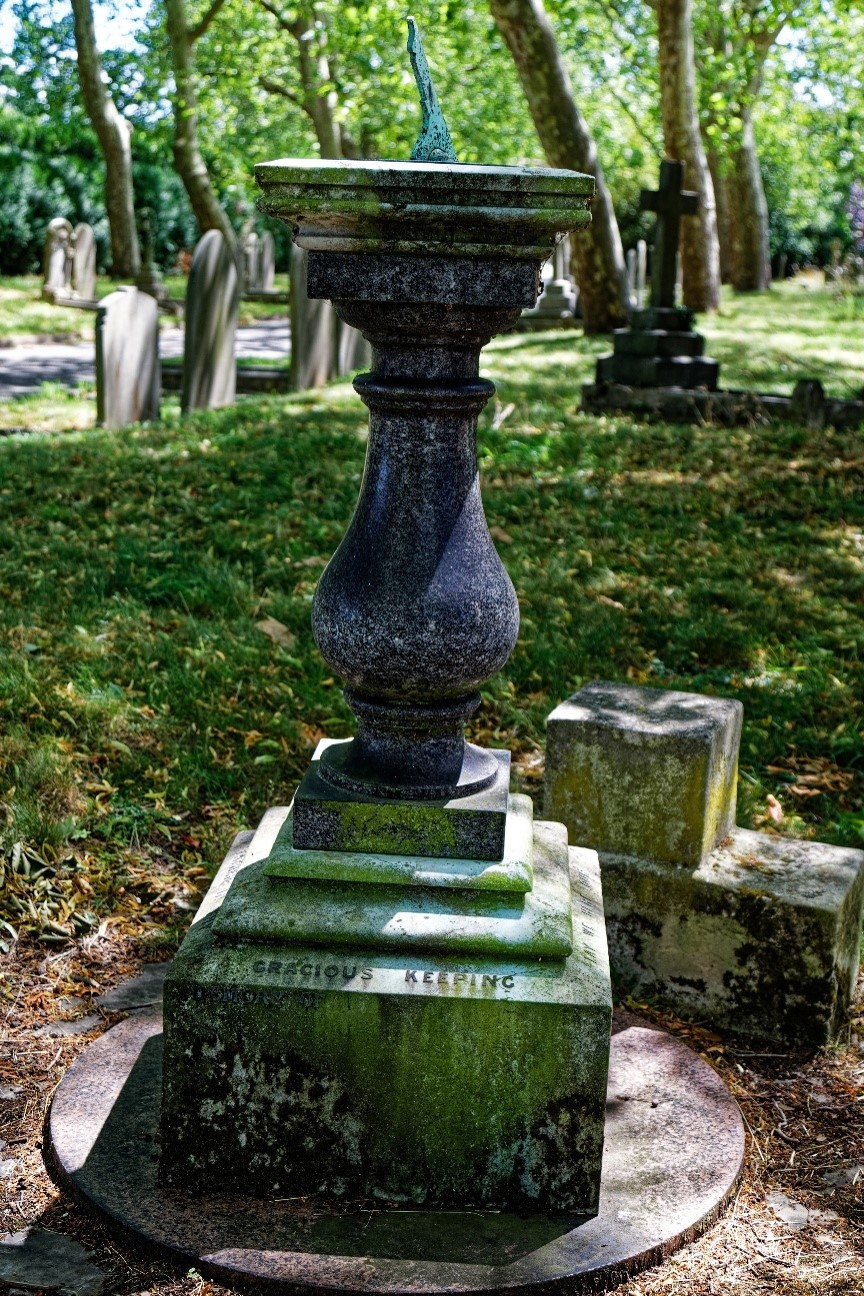
Tregurtha Family Memorial Sundial, City of London Cemetery
The life and times of Clerkenwell residents during Samuel’s lifetime were immortalised not only in Charles Dickens’ Oliver Twist, but also in George Grissling’s The Nether World (1889), and Arnold Bennett’s Riceyman Steps (1923); all three books would be worth reading to get a richer glimpse of the life Samuel Theophilus Tregurtha lived.